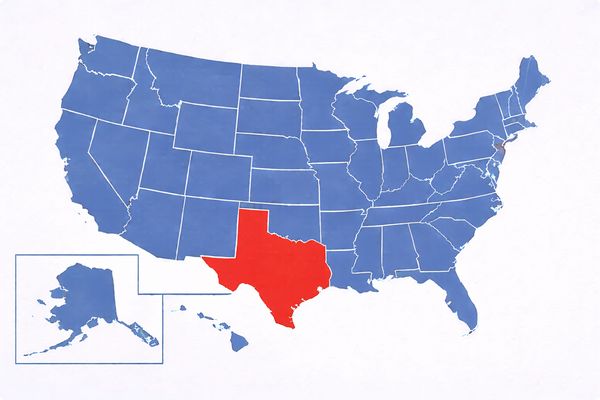
Texas Overview
State Name: Texas
Abbreviation: TX
Capital: Austin
Largest City: Houston
Statehood Date: December 29, 1845 (28th state)
Time Zone: Central Time (most of the state), Mountain Time (far west Texas)
Nicknames: The Lone Star State
Motto: Friendship
Location & Geography of Texas
Texas is located in the South-Central United States and is the second-largest state in the country by both area and population. It borders Oklahoma to the north, Arkansas to the northeast, Louisiana to the east, the Gulf of Mexico to the southeast, and Mexico to the south and southwest. It also borders New Mexico to the west.
Texas has extremely diverse geography including deserts, mountains, plains, forests, coastal beaches, and large river systems. West Texas includes desert and mountain landscapes, central Texas includes hills and plateaus, and eastern Texas has greener forests.
The state experiences a wide range of climates, from humid coastal weather near the Gulf to dry desert conditions in the west.
Major Cities & Regions of Texas
Houston: The largest city, known for energy, healthcare, and space research.
Dallas: Known for business, finance, and modern urban development.
Austin: The capital city, known for technology, live music, and startup culture.
San Antonio: Known for history, tourism, and cultural attractions.
Fort Worth: Known for cowboy culture, business growth, and arts.
Economy & Key Industries in Texas
Texas has one of the largest economies in the United States, supported by energy production, technology, healthcare, manufacturing, agriculture, aerospace, and logistics.
The state is a global leader in oil and gas, while also expanding strongly into renewable energy, especially wind and solar power.
Texas has major technology growth in Austin and Dallas, while Houston is known for energy and medical industries.
Agriculture remains important across rural Texas, including cattle ranching, cotton farming, and food production.
Government & Administration of Texas
Texas has an elected Governor and a bicameral legislature consisting of the Texas House of Representatives and Texas Senate.
The state is divided into 254 counties, the most of any US state.
Education in Texas
Texas has major universities such as the University of Texas at Austin, Texas A&M University, and Rice University.
The state supports higher education and research programs in engineering, medicine, business, and technology.
Transportation & Connectivity in Texas
Texas has a massive transportation network with major highways including I-10, I-35, I-45, and I-20 connecting key cities and regions.
Major airports include Dallas/Fort Worth International Airport (DFW), George Bush Intercontinental Airport (Houston), and Austin-Bergstrom International Airport.
Texas also has major ports such as the Port of Houston, supporting shipping, trade, and global commerce.
Tourism & Attractions in Texas
The Alamo (San Antonio): One of the most famous historic landmarks in the United States.
Big Bend National Park: Known for desert landscapes, mountains, and outdoor adventure.
Space Center Houston: A major attraction connected to NASA and space exploration.
River Walk (San Antonio): Famous for dining, shopping, and scenic city travel.
Austin Live Music: Austin is called the “Live Music Capital of the World.”
Best Time to Visit
The best time to visit Texas is during spring (March to May) and fall (September to November) when temperatures are comfortable for sightseeing and outdoor travel.
Summer can be extremely hot in many parts of the state, especially in central and southern regions, though coastal areas remain popular for beach travel.
Winter is mild in most areas, making it a good season for city travel and festivals.
Culture & Lifestyle in Texas
Texas has a unique culture influenced by Western traditions, Southern heritage, and Mexican-American history.
The state is known for barbecue, Tex-Mex cuisine, rodeos, country music, and strong sports culture.
Texas lifestyle varies from fast-paced big-city living to peaceful ranch and small-town life across rural areas.
History & Important Facts of Texas
Texas became the 28th state in 1845 and has a strong independent history, once being the Republic of Texas.
The state played a major role in frontier history and has many preserved historic landmarks.
Texas has grown into one of the most economically powerful and culturally influential states in the United States.
Cost of Living & Living Conditions in Texas
Texas has a moderate cost of living, though major metro areas like Austin have become more expensive due to rapid growth.
Housing is often more affordable compared to many coastal states, especially in suburban and smaller city areas.
Job opportunities are strong in energy, technology, healthcare, logistics, manufacturing, and business services.
Unique Highlights / Fun Facts about Texas
1) Texas is the second-largest US state by area and population.
2) The state is called the “Lone Star State” because of its independent history.
3) Texas has 254 counties, more than any other state in the US.
4) Austin is one of the fastest-growing technology hubs in the United States.
5) Texas is famous for BBQ, rodeos, and big cultural festivals.
Summary of Texas
Texas is one of the most powerful and diverse states in the United States, known for major cities, strong economy, unique culture, and wide landscapes ranging from deserts to coastlines. With attractions like the Alamo, Big Bend, and vibrant cities like Austin and Houston, Texas offers unmatched travel experiences, business opportunity, and lifestyle variety.