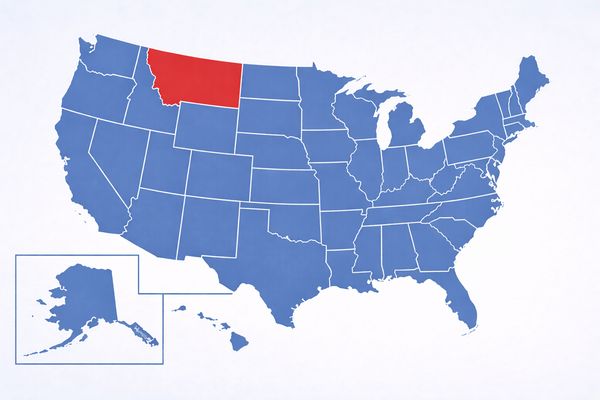
Montana Overview
State Name: Montana
Abbreviation: MT
Capital: Helena
Largest City: Billings
Statehood Date: November 8, 1889 (41st state)
Time Zone: Mountain Time
Nicknames: Big Sky Country, The Treasure State
Motto: Oro y Plata (Gold and Silver)
Location & Geography of Montana
Montana is located in the Northwestern United States and is known for wide open spaces and dramatic natural beauty. It borders Canada to the north, North Dakota and South Dakota to the east, Wyoming to the south, and Idaho to the west.
The western part of Montana is dominated by the Rocky Mountains, with forests, alpine lakes, and mountain valleys. Eastern Montana features plains, prairies, and rolling hills.
Montana has a continental climate with cold winters and warm summers, with weather varying greatly depending on altitude and region.
Major Cities & Regions of Montana
Billings: The largest city, known for business, healthcare, and regional trade.
Missoula: Known for university life, outdoor culture, and arts.
Bozeman: A fast-growing city known for technology, tourism, and access to Yellowstone.
Great Falls: Known for history, industry, and river landscapes.
Helena: The capital city, known for government and mountain scenery.
Economy & Key Industries in Montana
Montana’s economy is supported by agriculture, ranching, tourism, energy, mining, manufacturing, and healthcare.
The state is known for cattle ranching and farming products such as wheat and barley.
Tourism is one of Montana’s biggest industries, with visitors traveling to national parks, mountain towns, and outdoor adventure destinations.
Montana also has energy resources including coal and renewable energy development in certain regions.
Government & Administration of Montana
Montana has an elected Governor and a bicameral legislature consisting of the Montana House of Representatives and Montana Senate.
The state is divided into 56 counties, each providing local services and administration.
Education in Montana
Montana has major universities such as the University of Montana (Missoula) and Montana State University (Bozeman).
The state supports public education systems across rural and urban areas and provides workforce development programs related to agriculture and technology.
Transportation & Connectivity in Montana
Major highways include I-90 and I-15, which connect Montana’s cities and travel routes across the region.
Billings Logan International Airport and other regional airports support travel across Montana and the western US.
Transportation in Montana often includes long-distance driving due to the state’s large size and low population density.
Tourism & Attractions in Montana
Glacier National Park: One of the most famous parks in the US, known for glaciers, alpine lakes, and scenic drives.
Yellowstone (Montana region): Montana provides major access points to Yellowstone National Park.
Flathead Lake: One of the largest natural freshwater lakes in the US, known for boating and summer travel.
Big Sky Resort: A popular destination for skiing and mountain tourism.
Little Bighorn Battlefield: A historic site known for American frontier history.
Best Time to Visit
The best time to visit Montana is during summer (June to August) when national parks and scenic areas are fully open and ideal for hiking and outdoor adventure.
Fall (September to October) is also a great time with fewer crowds and beautiful seasonal colors.
For skiing and snow activities, winter (December to March) is best, especially around Big Sky and mountain regions.
Culture & Lifestyle in Montana
Montana is known for its outdoor lifestyle, with strong traditions in hiking, hunting, fishing, camping, and ranch living.
The state has a culture shaped by Native American heritage, frontier history, and small-town communities.
Montana is also known for its peaceful lifestyle, wide open landscapes, and strong connection to nature.
History & Important Facts of Montana
Montana became the 41st state in 1889 and has a history shaped by Native American communities, mining booms, and ranching growth.
The state played an important role during westward expansion and has preserved many historic frontier towns.
Montana is famous for its natural treasures, especially Glacier National Park and Yellowstone region travel.
Cost of Living & Living Conditions in Montana
Montana has a moderate cost of living, though popular areas like Bozeman and resort destinations can be more expensive.
Smaller towns and rural regions remain more affordable and offer quiet lifestyles.
Job opportunities are strong in tourism, healthcare, agriculture, energy, and construction.
Unique Highlights / Fun Facts about Montana
1) Montana is called “Big Sky Country” because of its wide open landscapes and huge skies.
2) Glacier National Park is one of the most scenic national parks in the United States.
3) Montana has one of the lowest population densities in the US, with vast open land.
4) The state has strong cowboy and ranching traditions.
5) Montana is a top destination for outdoor adventure and wildlife viewing.
Summary of Montana
Montana is a breathtaking northwestern state known for its mountains, national parks, wide open prairies, and outdoor adventure lifestyle. With attractions like Glacier National Park, Flathead Lake, and access to Yellowstone, Montana offers a perfect mix of nature, history, and peaceful living.