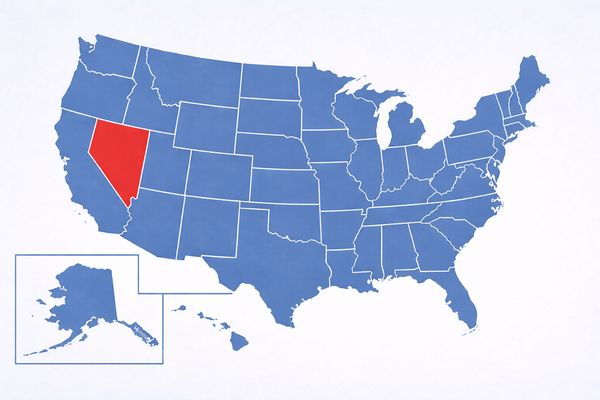
Nevada Overview
State Name: Nevada
Abbreviation: NV
Capital: Carson City
Largest City: Las Vegas
Statehood Date: October 31, 1864 (36th state)
Time Zone: Pacific Time (most of the state), Mountain Time (some border areas)
Nicknames: The Silver State
Motto: All For Our Country
Location & Geography of Nevada
Nevada is located in the Western United States. It borders Oregon and Idaho to the north, Utah to the east, Arizona to the southeast, and California to the west.
The state is known for its desert landscapes, mountain ranges, valleys, and wide open spaces. Nevada is one of the driest states in the US and features large areas of arid terrain.
Nevada’s geography includes the Great Basin in the north and central regions, with rugged mountain peaks and high desert areas. Southern Nevada is home to warmer desert climates and famous natural attractions.
Major Cities & Regions of Nevada
Las Vegas: The largest city, known worldwide for entertainment, casinos, nightlife, and tourism.
Reno: Known for gaming, outdoor access, and being close to Lake Tahoe.
Henderson: A major city near Las Vegas with strong residential and business growth.
Carson City: The capital city, known for government and historic charm.
Sparks: A growing city near Reno known for industry and community development.
Economy & Key Industries in Nevada
Nevada’s economy is strongly driven by tourism, entertainment, hospitality, gaming, and conventions, especially in Las Vegas.
The state also has major industries in mining, manufacturing, renewable energy, logistics, and technology.
Nevada is one of the top mining states in the US, producing valuable minerals such as gold and silver.
Reno and surrounding areas are growing rapidly in logistics and technology-related businesses.
Government & Administration of Nevada
Nevada has an elected Governor and a bicameral legislature consisting of the Nevada Assembly and Nevada Senate.
The state is divided into 17 counties, each providing local services and administration.
Education in Nevada
Nevada has major universities such as the University of Nevada, Reno (UNR) and the University of Nevada, Las Vegas (UNLV).
The state supports public education systems across counties and higher education programs focused on business, hospitality, engineering, and research.
Transportation & Connectivity in Nevada
Major highways include I-15, I-80, and US Route 95, connecting Nevada to key regions in the West.
Harry Reid International Airport (Las Vegas) is the main airport and one of the busiest in the United States.
Reno-Tahoe International Airport is another important travel hub supporting northern Nevada.
Nevada has strong road connectivity for tourism travel, especially to desert attractions and national parks nearby.
Tourism & Attractions in Nevada
Las Vegas Strip: One of the most famous entertainment destinations in the world.
Hoover Dam: A major engineering landmark near Las Vegas.
Lake Tahoe: A scenic destination for skiing, boating, and outdoor tourism (shared with California).
Red Rock Canyon: Known for hiking, rock formations, and desert scenery near Las Vegas.
Valley of Fire State Park: Famous for red sandstone landscapes and photography.
Best Time to Visit
The best time to visit Nevada is during spring (March to May) and fall (September to November) when temperatures are comfortable for outdoor travel and sightseeing.
Summer can be extremely hot in southern Nevada, especially in Las Vegas and desert regions, but it remains popular for indoor entertainment and resorts.
Winter is a great season to visit Lake Tahoe for skiing and snow activities, while Las Vegas stays mild and comfortable.
Culture & Lifestyle in Nevada
Nevada has a unique lifestyle influenced by entertainment, tourism, and outdoor desert adventure.
Las Vegas is known for nightlife, shows, and international events, while northern Nevada has more relaxed mountain-town culture.
The state also has strong cultural diversity, with food, music, and festivals influenced by visitors from around the world.
History & Important Facts of Nevada
Nevada became the 36th state in 1864 during the American Civil War and is sometimes called the “Battle Born State.”
The state’s history includes major mining booms, frontier settlement, and the rise of Las Vegas as a global entertainment capital.
Nevada has also played a role in US military history, with large areas used for training and testing.
Cost of Living & Living Conditions in Nevada
Nevada has a moderate cost of living, though Las Vegas and Reno have become more expensive due to rapid growth.
Housing costs are generally lower than some nearby coastal states, but demand has increased in recent years.
Job opportunities are strong in tourism, hospitality, mining, logistics, healthcare, and technology.
Unique Highlights / Fun Facts about Nevada
1) Nevada is the driest state in the United States.
2) Las Vegas is one of the world’s top entertainment destinations.
3) Nevada is known as the “Silver State” because of its mining history.
4) The Hoover Dam is one of the most impressive engineering projects in the US.
5) Lake Tahoe offers world-class skiing and summer lake tourism.
Summary of Nevada
Nevada is a western state known for Las Vegas entertainment, desert landscapes, mining strength, and outdoor adventure destinations like Lake Tahoe and Red Rock Canyon. With a growing economy and diverse travel experiences, Nevada offers an exciting mix of modern tourism, natural beauty, and unique lifestyle.