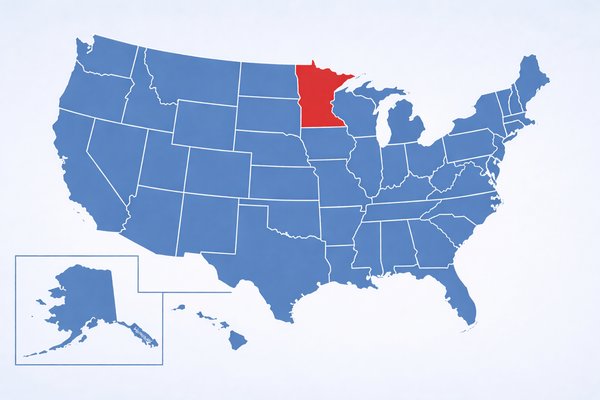
Minnesota Overview
State Name: Minnesota
Abbreviation: MN
Capital: Saint Paul
Largest City: Minneapolis
Statehood Date: May 11, 1858 (32nd state)
Time Zone: Central Time
Nicknames: The North Star State, Land of 10,000 Lakes
Motto: L'Étoile du Nord (The Star of the North)
Location & Geography of Minnesota
Minnesota is located in the Upper Midwest region of the United States. It borders Canada to the north, Wisconsin to the east, Iowa to the south, and North Dakota and South Dakota to the west.
The state is known for its lakes, forests, rivers, and wide-open landscapes. Minnesota has more than 10,000 lakes, including Lake Minnetonka and parts of Lake Superior along its northeastern border.
Minnesota has a humid continental climate with warm summers and long, cold winters. Snowfall is common, especially in northern regions, making it a popular state for winter activities.
Major Cities & Regions of Minnesota
Minneapolis: The largest city, known for business, culture, arts, and modern city life.
Saint Paul: The capital city, known for government, history, and the Mississippi River waterfront.
Duluth: A major port city on Lake Superior, known for scenic views and outdoor tourism.
Rochester: Known for healthcare, education, and medical research.
Bloomington: Known for shopping, tourism, and strong suburban development.
Economy & Key Industries in Minnesota
Minnesota has a strong and diverse economy supported by healthcare, manufacturing, technology, retail, agriculture, finance, and education.
The state is known for major medical and healthcare services, especially in Rochester, which attracts visitors from around the world.
Agriculture is important across southern Minnesota, with products including corn, soybeans, dairy, and livestock.
Minnesota also has strong manufacturing and business growth, especially in the Minneapolis–Saint Paul metro region.
Government & Administration of Minnesota
Minnesota has an elected Governor and a bicameral legislature consisting of the Minnesota House of Representatives and Minnesota Senate.
The state is divided into 87 counties, each providing local administration and public services.
Education in Minnesota
Minnesota has well-known universities such as the University of Minnesota, Minnesota State University system, and several private colleges.
The state supports strong public education systems and has a reputation for quality learning and research programs.
Higher education plays a major role in Minnesota’s workforce development and technology growth.
Transportation & Connectivity in Minnesota
Major highways include I-35, I-94, and I-90, connecting Minnesota to major Midwest routes.
Minneapolis–Saint Paul International Airport (MSP) is the main airport and one of the busiest in the region.
Minnesota also has strong freight transportation through rail networks and river transport along the Mississippi River.
Public transportation is available in the Twin Cities metro area, including light rail and bus services.
Tourism & Attractions in Minnesota
Mall of America (Bloomington): One of the largest shopping and entertainment malls in the United States.
Boundary Waters Canoe Area Wilderness: A world-famous destination for canoeing, camping, and nature travel.
North Shore (Lake Superior): Known for scenic drives, cliffs, waterfalls, and outdoor adventure.
Minnehaha Falls (Minneapolis): A popular city nature attraction with trails and park views.
Voyageurs National Park: Known for lakes, boating, wildlife, and peaceful wilderness travel.
Best Time to Visit
The best time to visit Minnesota is during summer (June to August) for lake activities, outdoor festivals, hiking, and sightseeing.
Fall (September to October) is also a great time to visit for colorful autumn scenery and comfortable weather.
For snow lovers, winter (December to February) is best for ice fishing, skiing, snowmobiling, and winter festivals.
Culture & Lifestyle in Minnesota
Minnesota is known for its friendly communities, strong family values, and outdoor lifestyle.
The state has a rich cultural mix influenced by Scandinavian and German heritage, along with Native American communities and modern urban diversity.
Minnesota offers strong arts, music, theater, and sports culture, especially in the Twin Cities region.
History & Important Facts of Minnesota
Minnesota became the 32nd state in 1858 and has a history shaped by Native American heritage, fur trading, logging, and farming growth.
The state developed strongly through river trade and natural resource industries.
Minnesota has long been known for its strong community development and high quality of life in many cities.
Cost of Living & Living Conditions in Minnesota
Minnesota has a moderate cost of living, with higher costs in Minneapolis and surrounding metro areas compared to smaller towns.
The state offers strong job opportunities in healthcare, technology, education, manufacturing, and finance.
Minnesota is known for good public services, clean environments, and balanced urban and rural lifestyles.
Unique Highlights / Fun Facts about Minnesota
1) Minnesota is known as the “Land of 10,000 Lakes” because of its huge number of lakes and waterways.
2) The Mississippi River begins in Minnesota at Lake Itasca.
3) The Boundary Waters is one of the best canoeing wilderness regions in the United States.
4) Minnesota has strong Scandinavian cultural influence in food, traditions, and lifestyle.
5) The Twin Cities (Minneapolis and Saint Paul) form one of the largest metro areas in the Midwest.
Summary of Minnesota
Minnesota is a beautiful Upper Midwest state known for its lakes, outdoor lifestyle, strong economy, and vibrant Twin Cities metro region. With attractions like the Boundary Waters, Lake Superior’s North Shore, and the Mall of America, Minnesota offers a perfect blend of nature, culture, and modern living.