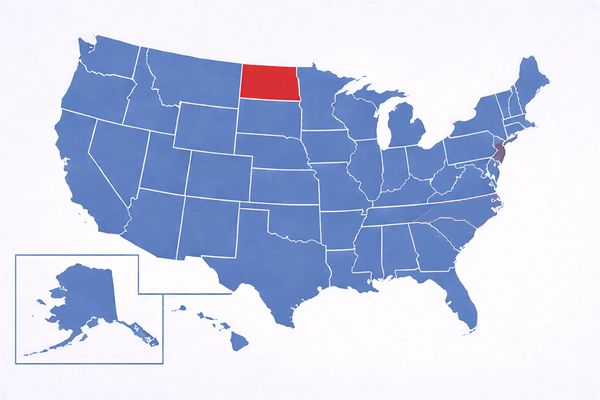
North Dakota Overview
State Name: North Dakota
Abbreviation: ND
Capital: Bismarck
Largest City: Fargo
Statehood Date: November 2, 1889 (39th state)
Time Zone: Central Time (most of the state), Mountain Time (some western areas)
Nicknames: The Peace Garden State, The Flickertail State
Motto: Liberty and Union, Now and Forever, One and Inseparable
Location & Geography of North Dakota
North Dakota is located in the Upper Midwest region of the United States. It borders Canada to the north, Minnesota to the east, South Dakota to the south, and Montana to the west.
The state is known for wide open prairies, farmland, rolling plains, and river valleys. The Missouri River is one of the most important waterways in North Dakota and supports agriculture and recreation.
North Dakota has a continental climate with warm summers, long cold winters, and strong winds. Snowfall and freezing temperatures are common during winter.
Major Cities & Regions of North Dakota
Fargo: The largest city, known for education, business growth, and a strong regional economy.
Bismarck: The capital city, known for government and Missouri River scenery.
Grand Forks: Known for universities, aviation, and community lifestyle.
Minot: A key northern city known for military presence and regional development.
Williston: Known for energy development and oil industry growth.
Economy & Key Industries in North Dakota
North Dakota’s economy is supported by agriculture, energy production, manufacturing, transportation, and services.
The state is a major producer of wheat, barley, sunflowers, and other crops, making farming one of its strongest industries.
Energy production is also important, especially oil extraction in the western part of the state.
North Dakota has also expanded in wind energy and related renewable energy development.
Government & Administration of North Dakota
North Dakota has an elected Governor and a bicameral legislature consisting of the North Dakota House of Representatives and North Dakota Senate.
The state is divided into 53 counties, each providing local services and administration.
Education in North Dakota
North Dakota has major universities such as North Dakota State University (Fargo) and the University of North Dakota (Grand Forks).
The state supports education and workforce programs in agriculture, engineering, aviation, healthcare, and technology.
Transportation & Connectivity in North Dakota
Major highways include I-94 and I-29, connecting North Dakota to neighboring states and central US routes.
Hector International Airport (Fargo) is one of the main airports, along with regional airports in other cities.
North Dakota has strong rail and trucking routes supporting agriculture and energy exports.
Tourism & Attractions in North Dakota
Theodore Roosevelt National Park: Known for badlands scenery, wildlife, and hiking.
International Peace Garden: A famous cross-border garden shared with Canada.
Medora: A popular small town known for western-style tourism and outdoor experiences.
Fort Union Trading Post: A historic site connected to fur trade and frontier history.
Scandinavian Heritage Park (Minot): A cultural attraction celebrating Nordic heritage.
Best Time to Visit
The best time to visit North Dakota is during late spring (May to June) and summer (July to August) when temperatures are warmer and outdoor travel is most comfortable.
Fall (September) is also a nice season with cooler weather and fewer crowds.
Winter is extremely cold and is best only for travelers who enjoy snow experiences and winter sports.
Culture & Lifestyle in North Dakota
North Dakota is known for small-town living, strong farming traditions, and friendly Midwestern communities.
The state has cultural influences from Scandinavian and German heritage, along with Native American communities.
Outdoor activities such as hunting, fishing, hiking, and winter sports are common across the state.
History & Important Facts of North Dakota
North Dakota became the 39th state in 1889 and developed strongly through farming, railroads, and settlement growth.
The state has strong Native American heritage, with several reservations and cultural communities.
North Dakota also played an important role in frontier trade and agricultural expansion across the Great Plains.
Cost of Living & Living Conditions in North Dakota
North Dakota generally has a moderate cost of living with affordable housing in many areas.
Fargo tends to have higher living costs compared to smaller towns due to growth and demand.
Job opportunities are strong in agriculture, energy, healthcare, education, transportation, and manufacturing.
Unique Highlights / Fun Facts about North Dakota
1) North Dakota is called the “Peace Garden State” because of the International Peace Garden on the Canadian border.
2) The state is one of the top producers of sunflowers and wheat in the United States.
3) Theodore Roosevelt National Park offers some of the most scenic badlands landscapes in the Midwest.
4) North Dakota has strong Scandinavian cultural influence in food, traditions, and festivals.
5) The state experiences long, cold winters and wide open prairie skies.
Summary of North Dakota
North Dakota is a peaceful and scenic Great Plains state known for farming, energy production, and beautiful badlands landscapes. With attractions like Theodore Roosevelt National Park and the International Peace Garden, North Dakota offers a quiet travel experience and strong community lifestyle.