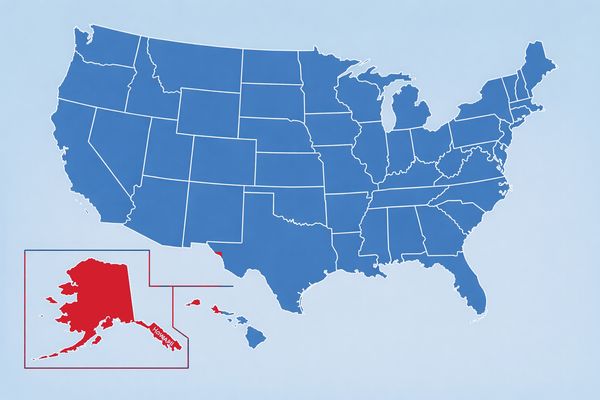
Alaska Overview
State Name: Alaska
Abbreviation: AK
Capital: Juneau
Largest City: Anchorage
Statehood Date: January 3, 1959 (49th state)
Time Zone: Alaska Time (most of the state)
Nicknames: The Last Frontier, The Land of the Midnight Sun
Motto: North to the Future
Location & Geography of Alaska
Alaska is the largest state in the United States and is located in the far northwest of North America. It is separated from the contiguous US and shares a border with Canada to the east.
Alaska is surrounded by the Arctic Ocean to the north, the Pacific Ocean to the south, and the Bering Sea to the west, giving it one of the most diverse coastlines in the world.
The state is known for its dramatic landscapes including massive glaciers, rugged mountains, wide tundra regions, deep forests, and thousands of rivers and lakes.
Major Cities & Regions of Alaska
Anchorage: The largest city and the main economic center, known for transport, tourism, and business.
Juneau: The capital city, famous for scenic views, glaciers, and government administration.
Fairbanks: Known for northern lights viewing, extreme winters, and access to the Arctic.
Nome: A historic gold rush town known for culture and remote wilderness.
Barrow (Utqiaġvik): One of the northernmost communities in the US, known for Arctic life and polar seasons.
Economy & Key Industries in Alaska
Alaska’s economy is strongly influenced by natural resources, especially oil and gas production, which has historically been one of the state’s biggest revenue sources.
Fishing and seafood processing are also major industries, making Alaska one of the most important fishing regions in the United States.
Tourism plays a major role, with visitors coming for glaciers, wildlife, cruises, national parks, and adventure travel.
Government & Administration of Alaska
Alaska has an elected Governor and a state legislature consisting of the Alaska House of Representatives and Alaska Senate.
The state is divided into boroughs and census areas, which function similarly to counties in other states.
Education in Alaska
The University of Alaska system is the main public university network in the state, with campuses in Anchorage, Fairbanks, and Southeast Alaska.
Education in Alaska includes public school districts serving both urban and remote communities, along with private schooling options in larger cities.
Transportation & Connectivity in Alaska
Transportation in Alaska is unique because many areas are not connected by roads and rely on air travel, ferries, and seasonal routes.
Major airports include Ted Stevens Anchorage International Airport and Fairbanks International Airport, which support both passenger and cargo travel.
Alaska also has important ports and ferry routes, including the Alaska Marine Highway System that connects many coastal communities.
Tourism & Attractions in Alaska
Denali National Park: Home to Denali (North America’s tallest peak) and famous for wildlife and scenic wilderness.
Glacier Bay National Park: Known for glaciers, fjords, and marine wildlife.
Kenai Fjords National Park: Popular for boat tours, glaciers, and whale watching.
Anchorage: A base city for exploring Alaska, museums, and outdoor activities.
Fairbanks: One of the best places to view the Northern Lights.
Best Time to Visit
The best time to visit Alaska is usually during summer (June to August) when days are long, temperatures are milder, and most tourist services are fully open.
If you want to see the Northern Lights, the best time is typically late fall to early spring (September to March), when nights are darker and skies can be clearer.
For snow activities like dog sledding and winter adventures, December to February is ideal in many areas.
Culture & Lifestyle in Alaska
Alaska has a rich cultural mix shaped by Indigenous communities, frontier history, and modern American life.
Native Alaskan cultures play a major role in traditions, festivals, art, and daily life across the state.
Outdoor adventure is a major part of lifestyle, with fishing, hiking, hunting, snow sports, and wildlife exploration being extremely popular.
History & Important Facts of Alaska
Alaska was purchased from Russia by the United States in 1867 and later became the 49th US state in 1959.
The state played a major role in World War II in the Pacific region and later became strategically important during the Cold War.
Alaska’s gold rush history and native heritage are major parts of its identity.
Cost of Living & Living Conditions in Alaska
Alaska can have a higher cost of living compared to many US states, especially in remote regions where goods and services require expensive transportation.
Larger cities like Anchorage offer more job options, better connectivity, and easier access to supplies than smaller towns.
Job opportunities are strong in energy, fishing, tourism, transportation, and government-related roles.
Unique Highlights / Fun Facts about Alaska
1) Alaska is the largest US state and has more coastline than all other states combined.
2) It is home to Denali, the tallest mountain in North America.
3) Alaska has incredible wildlife including bears, moose, wolves, whales, and bald eagles.
4) The state experiences the “Midnight Sun” in summer and long polar nights in winter.
5) Many Alaskan communities are only reachable by plane or boat, making travel very unique.
Summary of Alaska
Alaska is one of the most unique and breathtaking states in the United States, known for its massive size, wild landscapes, glaciers, mountains, and wildlife. It is a top destination for adventure tourism, fishing, and nature lovers, while also offering rich Indigenous culture and history.