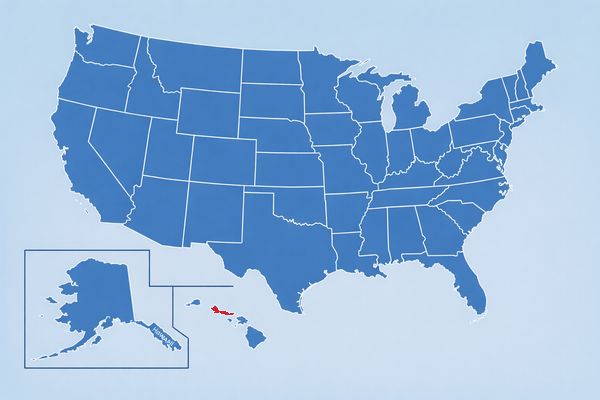
Hawaii Overview
State Name: Hawaii
Abbreviation: HI
Capital: Honolulu
Largest City: Honolulu
Statehood Date: August 21, 1959 (50th state)
Time Zone: Hawaii-Aleutian Time (no daylight saving time)
Nicknames: The Aloha State
Motto: Ua Mau ke Ea o ka ʻĀina i ka Pono (The life of the land is perpetuated in righteousness)
Location & Geography of Hawaii
Hawaii is the only US state made up entirely of islands and is located in the central Pacific Ocean. It is thousands of miles away from the mainland United States, making it one of the most unique and remote states in the country.
The state consists of eight main islands, including Oahu, Maui, Hawaii (Big Island), Kauai, Molokai, Lanai, Niihau, and Kahoolawe. Each island has its own personality, landscapes, and travel experiences.
Hawaii is famous for its volcanic mountains, tropical beaches, rainforests, waterfalls, coral reefs, and stunning coastal scenery. The islands were formed by volcanic activity and continue to evolve through natural forces.
Major Cities & Islands of Hawaii
Honolulu (Oahu): The capital and largest city, known for Waikiki Beach, business, and tourism.
Maui: Famous for luxury resorts, scenic drives, and whale watching.
Big Island (Hawaii Island): Known for active volcanoes, black sand beaches, and diverse landscapes.
Kauai: Called the “Garden Isle,” known for lush greenery and dramatic cliffs.
Lanai & Molokai: Known for peaceful travel, nature experiences, and cultural heritage.
Economy & Key Industries in Hawaii
Hawaii’s economy is strongly driven by tourism, hospitality, and travel services. Millions of visitors come each year to enjoy beaches, nature, resorts, and Hawaiian culture.
Other important industries include agriculture (especially tropical fruits and coffee), defense and military-related services, healthcare, and education.
Hawaii is also developing renewable energy initiatives, with goals focused on sustainability and reducing dependence on imported fuel.
Government & Administration of Hawaii
Hawaii has an elected Governor and a bicameral legislature consisting of the Hawaii House of Representatives and Hawaii Senate.
The state is divided into 5 counties, including Honolulu County, Maui County, Hawaii County, Kauai County, and Kalawao County.
Education in Hawaii
Hawaii’s major public university system is the University of Hawaii, with its main campus in Honolulu and additional campuses across the islands.
The state also has private colleges and strong educational programs connected to ocean science, astronomy, tourism, and environmental research.
Education and cultural learning are closely connected to Hawaiian traditions and community identity.
Transportation & Connectivity in Hawaii
Hawaii relies heavily on air travel for connecting islands and reaching the mainland. Major airports include Daniel K. Inouye International Airport (Honolulu) and Kahului Airport (Maui).
Inter-island flights are common, and ferries are limited. Roads are well-developed on the main islands, though travel is slower due to island geography and tourism traffic.
Hawaii also depends on shipping for goods and supplies, making ports important for the state economy.
Tourism & Attractions in Hawaii
Waikiki Beach (Oahu): One of the most famous beaches in the world, known for surfing and resorts.
Hawaii Volcanoes National Park (Big Island): A world-class volcanic park with unique landscapes.
Road to Hana (Maui): A scenic drive with waterfalls, rainforests, and viewpoints.
Na Pali Coast (Kauai): Known for dramatic cliffs, hiking, and boat tours.
Pearl Harbor (Oahu): A major historical site and memorial attraction.
Best Time to Visit
The best time to visit Hawaii is usually during spring (April to June) and fall (September to early December) when the weather is pleasant and crowds are smaller.
Winter (December to March) is very popular for whale watching and holiday travel, but it also brings higher prices and more visitors.
Summer (June to August) offers warm beach weather and family travel, though it can be busier due to peak vacation season.
Culture & Lifestyle in Hawaii
Hawaii has a unique culture shaped by Native Hawaiian traditions, Asian and Pacific Islander influences, and modern American life.
The spirit of “Aloha” is central to daily life, emphasizing respect, kindness, and community.
Local food culture includes dishes like poke, plate lunches, shave ice, and fresh seafood, along with strong farm-to-table influence.
History & Important Facts of Hawaii
Hawaii was once an independent kingdom and later became a US territory before becoming the 50th state in 1959.
The state has deep historical importance, including Pearl Harbor, which played a key role in World War II.
Hawaii also has major cultural and historical traditions that remain strong through festivals, language, and community life.
Cost of Living & Living Conditions in Hawaii
Hawaii has one of the highest costs of living in the United States due to its remote location and reliance on imported goods.
Housing, groceries, and transportation can be expensive, especially in Honolulu and major tourist areas.
Job opportunities are strong in tourism, hospitality, healthcare, education, and military-related sectors.
Unique Highlights / Fun Facts about Hawaii
1) Hawaii is the only US state made entirely of islands.
2) It is the 50th and most recent state to join the United States.
3) Hawaii has active volcanoes and some of the world’s most beautiful beaches.
4) The state experiences tropical weather year-round.
5) Hawaii is one of the top places in the world for surfing and ocean activities.
Summary of Hawaii
Hawaii is one of the most breathtaking and unique destinations in the United States, famous for its islands, beaches, volcanoes, and vibrant cultural heritage. With world-class tourism attractions, tropical climate, and the welcoming spirit of Aloha, Hawaii offers an unforgettable travel and lifestyle experience.