
Table of Contents
Overview
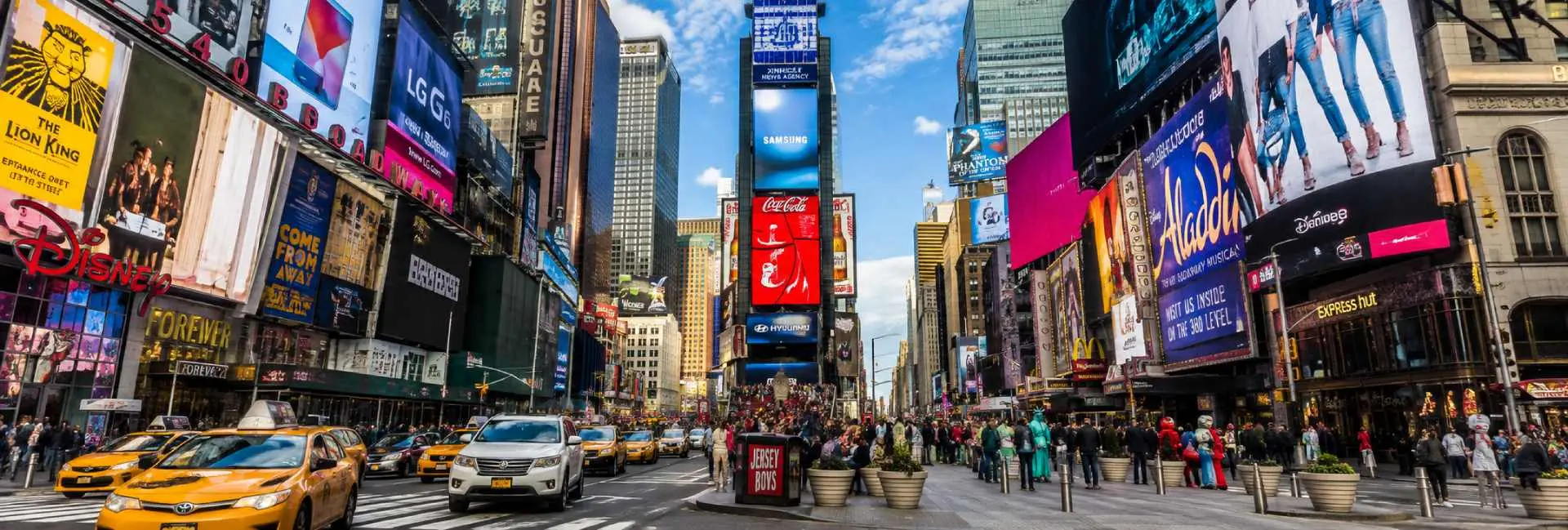
Times Square is the bowtie-shaped intersection formed where Broadway crosses Seventh Avenue in Midtown Manhattan, stretching roughly from 42nd Street to 47th Street. Wrapped in oversized digital billboards and flanked by dozens of Broadway theaters, it draws tens of millions of visitors a year and is often described as the busiest pedestrian crossroads in the world.
What sets Times Square apart from a typical city intersection is how deliberately its identity has been built around spectacle: a city zoning rule requires large, illuminated signage on many of its buildings, keeping the square lit around the clock. Beyond the lights, it's the symbolic heart of American theater, the staging ground for the annual New Year's Eve ball drop, and a starting point for exploring the wider Theater District that surrounds it.
History
From Longacre Square to Times Square
The area was known through the nineteenth century as Longacre Square, named after London's carriage-trade district, and had a reputation as a rougher part of Manhattan tied to the horse and carriage industry. That changed in 1904, when New York Times publisher Adolph Ochs relocated the newspaper's headquarters to a new tower at the square's southern tip and persuaded the city to build a subway station beneath it. On April 8, 1904, the district was officially renamed Times Square in the paper's honor, and the surge of subway riders it brought helped turn the area into one of the city's busiest commercial hubs almost overnight.
Lights, Theaters, and Decline
Electrified advertising arrived within weeks of the renaming, and by the 1920s and 1930s the square's blocks were lined with neon signage and dozens of new theaters, cementing its identity as the heart of the "Great White Way." That glamour faded through the mid-twentieth century, as the Times Square area slid into decades of disinvestment marked by adult theaters, crime, and a decaying theater stock through the 1970s and into the 1980s.
Redevelopment and Pedestrianization
A major public and private redevelopment push through the 1990s, backed by the city and business groups, cleared out much of the area's adult entertainment and brought in large retailers, family-oriented attractions, and restored theaters. The Walt Disney Company's renovation of the historic New Amsterdam Theatre in the mid-1990s is often cited as a turning point, drawing other major entertainment and retail brands into the district over the following years.
Closing the Square to Traffic
In 2009, the city closed Broadway to vehicle traffic between 42nd and 47th Streets on a trial basis, converting the roadway into car-free pedestrian plazas after years of studies showing that pedestrians already vastly outnumbered vehicles passing through. The change proved popular enough that it was made permanent the following year, with the plazas later redesigned with fixed granite seating, planters, and public art, and studies afterward pointed to gains in pedestrian safety and nearby retail activity.
Signage & Streetscape
Mandatory Illumination
Since the 1980s, city zoning rules covering the Times Square area have required certain building owners to display a minimum amount of illuminated signage, a regulation unusual for an American city and one that helps guarantee the square's density of digital advertising never fully dims. Sign space in the square is among the most expensive advertising real estate in the world, leased by a rotating roster of global brands.
A Bowtie, Not a Square
Despite its name, Times Square isn't a conventional square at all; its distinctive bowtie shape comes from Broadway cutting diagonally across the rigid Manhattan street grid where it meets Seventh Avenue. That diagonal intersection created the small triangular plazas, including Duffy Square at the square's north end, that now anchor much of the pedestrian space.
Recognition & Status
Times Square's fame rests less on formal historic designations than on its status as a cultural and economic symbol, though the surrounding Theater District includes numerous individually landmarked playhouses. It is widely nicknamed the "Crossroads of the World" and the heart of the "Great White Way," reflecting both its foot traffic and its concentration of illuminated signage and theaters.
- Home to more than 40 Broadway theaters in the surrounding Theater District
- Estimated tens of millions of visitors annually, among the most visited attractions in the United States
- Site of the annual New Year's Eve ball drop, broadcast to audiences worldwide
- Subject to city zoning rules requiring illuminated signage on qualifying buildings
What to See There
One Times Square and the Ball Drop
One Times Square, the former Times Building at the square's southern tip, is best known today as the site of the New Year's Eve ball drop, a tradition that began in 1907 as a replacement for an earlier rooftop fireworks display. The current ball, a geodesic sphere covered in thousands of LED lights, remains mounted atop the building year-round.
The TKTS Booth and Red Steps
In Duffy Square at the square's north end, the TKTS booth sells same-day discounted tickets to Broadway and Off-Broadway shows, and its illuminated red glass staircase has become a popular spot to sit and take in the surrounding billboards.
Broadway Theaters
The blocks radiating out from the square hold the highest concentration of Broadway theaters in the city, staging everything from long-running musicals to new productions, with marquees that are themselves part of the square's visual identity after dark. Many of these playhouses date to the early twentieth century and carry individual landmark protections of their own, giving the district an architectural layer that's easy to miss amid the billboards at street level.
Public Art and Recurring Installations
Beyond its permanent landmarks, Times Square regularly hosts temporary public art installations and sculpture commissions coordinated by the local business improvement district, along with recurring events like a midsummer mass yoga session held on the plazas. Costumed characters, from superheroes to cartoon figures, are a near-constant fixture among the crowds, posing for photos in exchange for tips.
Ways to Experience It
Walking the Plazas
The car-free pedestrian plazas along Broadway between 42nd and 47th Streets are free to walk through at any hour, with fixed seating areas that make it easy to pause and take in the billboards without fighting traffic.
Seeing a Broadway Show
Catching a show at one of the surrounding theaters is the classic way to experience the district beyond the square itself, whether booked in advance or picked up same-day at the TKTS booth for a discount.
Guided Tours and Observation Decks
Walking tours covering the square's history and architecture are available from several operators, and nearby observation decks, including ones on buildings just off the square, offer elevated views back down over the billboards and crowds. Backstage and theater tours are also available for a number of Broadway houses, giving a closer look at how the productions filling the marquees come together.
Shopping and Dining
Flagship stores for a number of major retailers line the square and its surrounding blocks, alongside chain restaurants and themed dining spots aimed squarely at visitors; travelers looking for more distinctive food generally do better walking a few blocks in any direction into the surrounding neighborhoods.
Best Time to Visit
Times Square is busy at essentially all hours, but crowd levels shift noticeably by time of day: early morning offers the clearest views of the billboards and easiest photos, while evenings bring the largest crowds along with the square at its most visually striking, since the signage is designed to be seen after dark.
Weekdays are generally calmer than weekends, and visiting outside the peak summer tourist season can mean noticeably thinner crowds. December brings an especially packed calendar of holiday shoppers and, by New Year's Eve itself, security barricades and enormous crowds gathered for the ball drop, an event that requires arriving many hours early to secure a viewing spot.
Visitor Tips
- Entry to the square and its plazas is free at all times; only specific attractions, shows, or observation decks require tickets
- Keep valuables secure and stay aware of surroundings, since dense crowds also draw pickpockets and aggressive costumed characters looking for tips
- Photographers with costumed characters or street performers often expect a cash tip, even if not asked upfront
- Buy Broadway tickets in advance for popular shows, or check the TKTS booth for same-day discounted seats
- Avoid driving through the area if possible, since the pedestrian plazas and heavy foot traffic make for slow, congested streets
- If attending the New Year's Eve ball drop, plan to arrive many hours ahead, dress warmly, and expect no bathroom access once inside the viewing pens
Nearby Attractions
Bryant Park and the New York Public Library's main branch sit a short walk south, offering a quieter green space and architectural landmark close to the square's constant activity. Rockefeller Center, with its own observation deck and seasonal ice rink, is a few blocks northeast.
The wider Theater District surrounding the square holds dozens of additional playhouses worth exploring beyond a single show, while Hell's Kitchen to the west offers a dense concentration of restaurants for a meal before or after a performance.
FAQs about visiting Times Square
Is Times Square free to visit? +
Yes, the square and its pedestrian plazas are open to the public at all hours with no entry fee; only specific attractions, shows, or observation decks nearby charge admission.
Why is it called Times Square? +
The area was renamed in 1904 after The New York Times moved its headquarters to a new tower there, replacing its earlier name, Longacre Square.
How do I watch the New Year's Eve ball drop? +
Viewing the ball drop in person means arriving in the designated viewing pens many hours before midnight, since areas fill up early and security closes access once they're full; many people instead watch the broadcast on television.
Are there pickpockets or scams in Times Square? +
As with any dense tourist crowd, it's worth keeping an eye on belongings, and costumed characters or street performers who pose for photos typically expect a cash tip even without asking directly.
What's the best time of day to see the lights? +
The billboards are most striking after dark, though visiting in the early morning offers a quieter, less crowded view if photos without crowds are the priority.
How do I get discounted Broadway tickets? +
The TKTS booth in Duffy Square, at the square's north end, sells same-day tickets to many Broadway and Off-Broadway shows at a discount.
Is Times Square walkable, or do I need transportation? +
It's highly walkable and served by multiple subway lines converging directly beneath it, making a car largely unnecessary and often impractical given the traffic and pedestrian plazas.