
Table of Contents
Overview
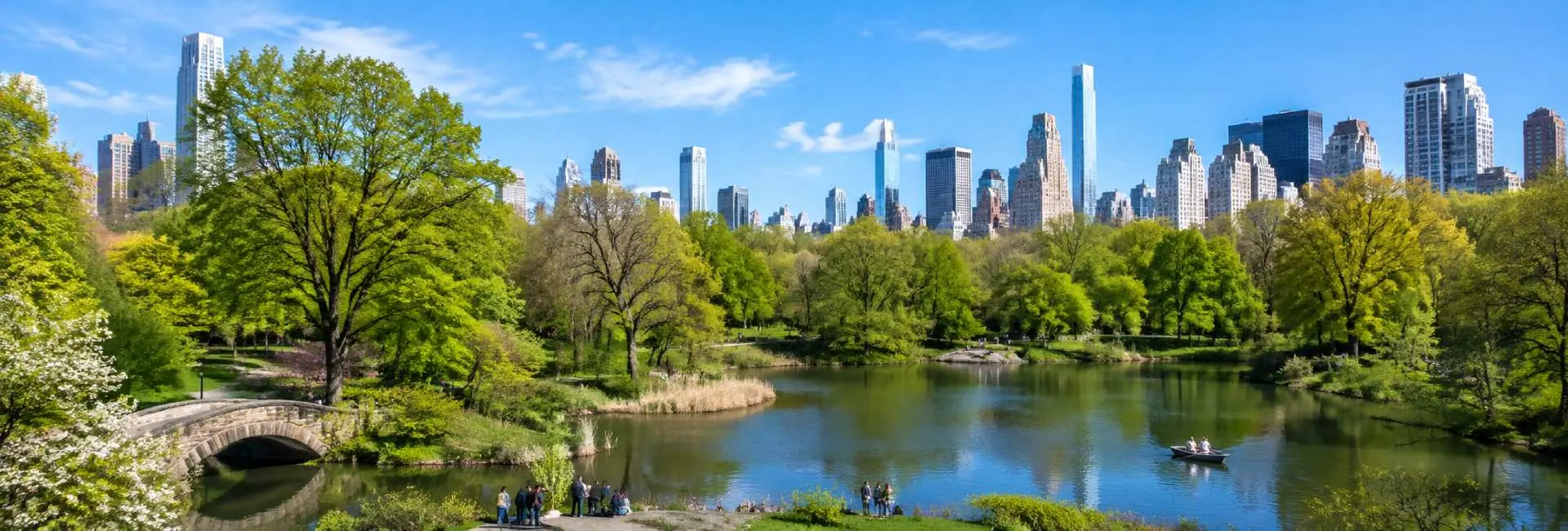
Central Park is an 843-acre swath of rolling lawns, woodland, lakes, and formal promenades set directly into the street grid of Manhattan, stretching from 59th Street up to 110th Street between Fifth Avenue and Central Park West. Opened in stages between 1858 and the 1870s, it was the first major landscaped public park built in the United States and remains the country's most visited urban park, drawing tens of millions of visits a year from New Yorkers and travelers alike.
What makes the park remarkable isn't untouched nature but the opposite: nearly every hill, pond, and outcrop was deliberately shaped by its designers to feel wild and unplanned. Free to enter and open daily, it functions as both a working city park, with ballfields, playgrounds, and a zoo, and a monument in its own right, packed with sculpture, architecture, and quiet corners that reward slow exploration.
History
Choosing a Site
Calls for a large public park in Manhattan grew through the early 1800s as the city's population swelled, and in 1853 the New York State Legislature authorized the city to acquire land for one. The site chosen was largely rocky, swampy, and considered unsuitable for development, but it wasn't empty: roughly 1,600 people were displaced to clear it, including the residents of Seneca Village, a settlement of about 264 people near what is now the park's west side at 82nd to 89th Streets, home to many free African American property owners along with Irish and German immigrant families.
The Greensward Plan
In 1857 and 1858, the park's commissioners ran a design competition that drew 33 entries. The winning proposal, submitted by the park's superintendent Frederick Law Olmsted together with architect Calvert Vaux, was called the Greensward Plan. It envisioned a naturalistic, English-style landscape of open meadows and picturesque woodland, deliberately contrasted with more formal features like a broad promenade and an ornamental terrace, and it separated pedestrian, carriage, and cross-town traffic using sunken roadways so through-traffic wouldn't disturb the park experience above.
Building the Park
Construction stretched roughly from 1857 to 1876 and cost some 14 million dollars, an enormous sum for the era. Crews moved vast quantities of soil and blasted rock to reshape the terrain, planted hundreds of thousands of trees and shrubs, and built the park's bridges, terraces, and drives largely by hand, with much of the heavy labor carried out by immigrant workers. The park has continued to evolve since, through periods of decline and disinvestment in the mid-twentieth century followed by a major restoration effort led by the Central Park Conservancy, a nonprofit founded in 1980 that has managed day-to-day operations and upkeep in partnership with the city since 1998.
Design & Layout
A Landscape Built to Look Natural
Every feature of Central Park, from its ponds to its rock outcrops, was engineered rather than found. Olmsted and Vaux organized the park around a sequence of contrasting scenes, meant to be experienced gradually on foot: broad open meadows give way to dense, tangled woodland, which opens again onto formal architectural set pieces, so that a walk through the park constantly shifts in mood and scale.
Traffic Below, Park Above
One of the plan's most influential ideas was sinking four transverse roads about eight feet below the park's surface to carry cross-town vehicle traffic from one side of Manhattan to the other without visually or physically interrupting the park itself. Pedestrian paths, bridle paths, and carriage drives were also kept largely separate from one another, a level of circulation planning that was considered groundbreaking at the time and influenced park design across the country.
Recognition & Status
Central Park's influence on landscape architecture and its role in New York City's civic life have earned it protection at the local, state, and federal levels. It was designated a National Historic Landmark in 1963 for its historical and design significance, added to the National Register of Historic Places in 1966, and formally recognized as a New York City Landmark in 1974.
- National Historic Landmark, designated 1963
- Listed on the National Register of Historic Places, 1966
- New York City Landmark (scenic landmark), designated 1974
- New York State Register of Historic Places listing
Key Areas & Landmarks
The Mall and Bethesda Terrace
The Mall is the park's grand formal promenade, lined with a canopy of American elms, leading north to Bethesda Terrace and its central fountain overlooking the lake, one of the most photographed spots in the park and a favored gathering point for musicians and street performers.
The Ramble and North Woods
The Ramble is a 36-acre stretch of winding, densely wooded paths designed to feel wild and disorienting, prized by birdwatchers for the songbirds that pass through on migration. Further north, the North Woods offers a rougher, more forested landscape with streams and rustic bridges, echoing the park's original naturalistic ambitions.
Open Lawns and Water
Sheep Meadow and the Great Lawn are the park's two largest open spaces, used for picnicking, sunbathing, and, in the case of the Great Lawn, occasional large concerts. The Jacqueline Kennedy Onassis Reservoir, ringed by a well-used running track, sits near the park's center, while smaller bodies of water like the Lake and the Harlem Meer offer boating and fishing respectively.
Other Notable Spots
Additional landmarks include Belvedere Castle, a small Victorian folly with panoramic views over the Great Lawn and Turtle Pond; Strawberry Fields, a memorial garden dedicated to John Lennon near the park's western edge across from the Dakota building; the Central Park Zoo, home to a compact but popular collection of animals near the park's southeast corner; Bow Bridge, a cast-iron footbridge over the Lake that's become one of the park's most photographed spots; and the Conservatory Garden, a formal six-acre garden of French, Italian, and English-style plantings near the park's northeast corner.
Ways to Experience It
On Foot or By Bike
Walking is the simplest way to see the park, with paved loops and countless smaller paths connecting its major landmarks. Bike rentals are available at multiple points around the park, and the roughly six-mile main loop drive is a popular route for cyclists and runners, especially during hours when it's closed to vehicle traffic.
Boating and Guided Tours
Rowboats and gondola rides are available on the Lake from the Loeb Boathouse, and guided walking tours, run by the Central Park Conservancy and independent operators, cover topics from the park's history and design to its wildlife and film locations.
Seasonal Events
The park hosts free outdoor performances through the warmer months, including Shakespeare in the Park at the Delacorte Theater and concerts on the Great Lawn, while Wollman Rink draws ice skaters in winter and the Central Park Conservancy runs seasonal programming like bird walks and garden tours tied to the changing landscape.
Best Time to Visit
Spring and fall offer the most comfortable weather for walking the park's paths, with flowering trees in April and May and colorful foliage in October, both of which draw larger weekend crowds to popular spots like the Mall and Bethesda Terrace. Weekday mornings tend to be quieter across all seasons, particularly in areas like the Ramble and North Woods.
Summer brings long days and a full calendar of outdoor performances and events, though midday heat and humidity can make exploring less comfortable; shaded paths through the Ramble offer relief. Winter is the quietest season overall, with the chance of a snow-covered landscape and ice skating at Wollman Rink, though some facilities and boat rentals close for the season.
Visitor Tips
- Entry to the park is free, with no tickets required for the grounds themselves; only specific attractions like the zoo or boat rentals charge a fee
- Pick up or download a park map before visiting, since the park's winding paths can be disorienting even for repeat visitors
- Wear comfortable shoes, as many of the park's best-known spots are a considerable walk from the nearest entrance
- Note that the park spans a wide range of neighborhoods, so choose an entrance close to the specific landmarks you want to see
- Cyclists and runners should watch for shared paths with pedestrians, particularly on weekends
- Check the schedule for seasonal closures of attractions like Wollman Rink or the boathouse before planning a visit around them
Nearby Attractions
The park is bordered by some of Manhattan's best-known museums, including the Metropolitan Museum of Art and the American Museum of Natural History, both a short walk from the park's east and west sides respectively. Just south of the park, Fifth Avenue's shopping district and landmarks like the Plaza Hotel and Grand Army Plaza make for an easy extension of a park visit.
To the north, neighborhoods like Harlem offer their own historic architecture and cultural institutions, while the Upper West Side and Upper East Side surrounding the park are lined with restaurants and cafes well suited to a break between park landmarks.
FAQs about visiting Central Park
Is Central Park free to visit? +
Yes, entry to the park's grounds is free at all times; only certain attractions inside, like the zoo, boat rentals, or guided tours, charge a separate fee.
How big is Central Park and how long does it take to see? +
The park covers 843 acres and stretches about 2.5 miles from south to north, so seeing a handful of highlights takes a couple of hours, while covering more ground comfortably can fill a half or full day.
What are the must-see spots for a first visit? +
Bethesda Terrace, the Mall, Strawberry Fields, and Bow Bridge are among the most popular landmarks for a first-time visit, all located in the park's more accessible southern half.
Is Central Park safe to walk through? +
The park is generally busy and well-patrolled during daylight hours, though like any large public space it's sensible to stick to populated paths, especially after dark.
Can you bike or run in Central Park? +
Yes, the park has dedicated paths and a roughly six-mile loop drive popular with runners and cyclists, along with bike rental locations near several entrances.
What's the best entrance to use? +
There's no single best entrance; it depends on which landmarks you want to see first, since the park has numerous entry points along Fifth Avenue, Central Park West, and the surrounding streets.
Are there guided tours of Central Park? +
Yes, the Central Park Conservancy and several independent operators offer walking tours covering the park's history, design, wildlife, and famous film and TV locations.