
Table of Contents
Overview
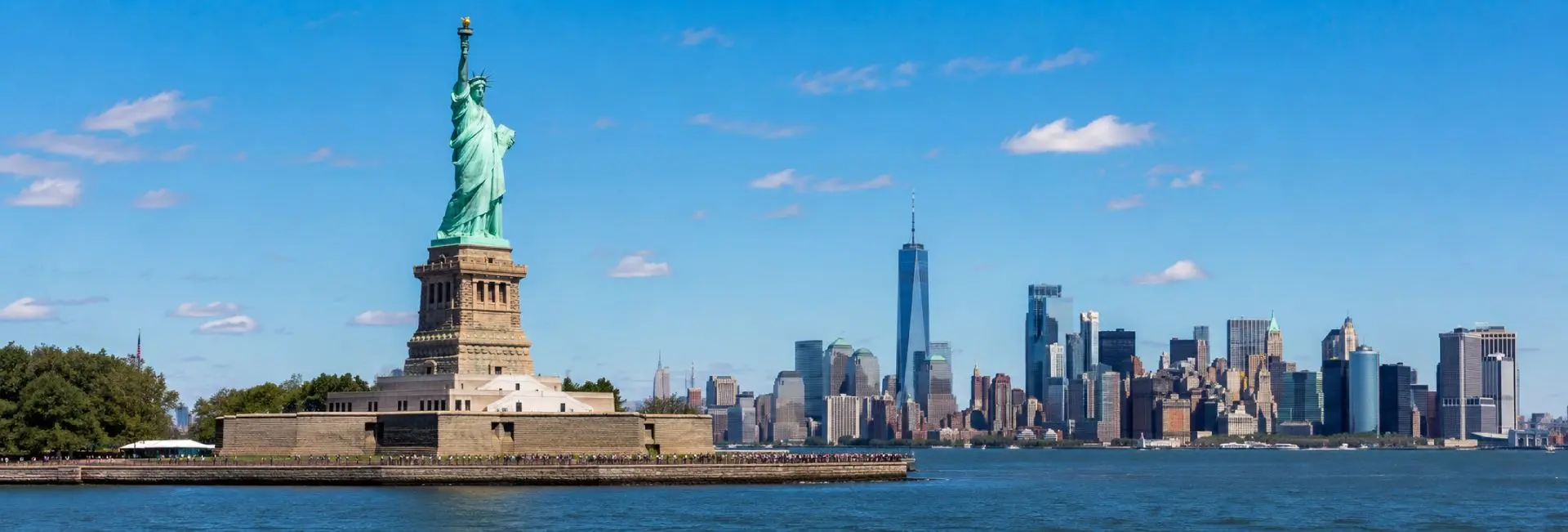
Rising from a small island in Upper New York Bay, the Statue of Liberty has greeted arrivals to New York Harbor for well over a century. Formally titled "Liberty Enlightening the World," the copper-clad figure was a gift from the people of France to the people of the United States, commemorating the two nations' shared democratic ideals. Standing 305 feet from the ground to the tip of her torch, she was among the tallest structures in the country when she was unveiled and remains one of the most recognized monuments on Earth.
Beyond her scale, the statue's lasting pull comes from what she represents: liberty, self-government, and, for generations of immigrants who sailed past her toward Ellis Island, the promise of a new start. Today, visitors reach Liberty Island by ferry to walk the surrounding grounds, tour the pedestal and museum, and, with advance reservations, climb into the crown itself.
History
An Idea Takes Shape
The concept originated in France in the 1860s, when legal scholar Edouard de Laboulaye proposed that his country present the United States with a monument marking the two nations' long friendship and their shared commitment to liberty, timed to the centennial of American independence in 1876. Sculptor Frederic-Auguste Bartholdi took up the project, traveling to the United States to scout a location and settling on a small harbor post then known as Bedloe's Island, at the gateway to New York.
Building a Giant
Bartholdi spent years shaping the statue's form in Paris, enlarging small studies into a full-scale figure built up from thin sheets of hammered copper over a skeleton of iron trusswork. That internal framework was engineered by Gustave Eiffel, who would later design the tower in Paris that bears his name, using a flexible structure that let the copper skin expand and contract with temperature without cracking. Funding followed a split arrangement: the French financed and built the statue itself, largely through public subscription, while Americans raised money for the pedestal, designed by architect Richard Morris Hunt and set atop the star-shaped walls of a disused army post called Fort Wood.
Arrival and Dedication
By 1885, the completed statue had been dismantled into more than 200 crates and shipped across the Atlantic aboard the French frigate Isere. American workers spent months reassembling it on its new pedestal, and on October 28, 1886, President Grover Cleveland presided over the dedication before a huge harbor crowd of ships and spectators. In the decades that followed, the statue's role deepened as millions of immigrants passed nearby en route to the processing station at Ellis Island, and in 1903 a bronze plaque bearing Emma Lazarus's poem "The New Colossus" was mounted inside the pedestal, cementing the statue's association with welcome and refuge.
Later Changes and Restoration
The statue's torch design changed more than once in its early decades as engineers tried to improve its glow at night, and the original flame was eventually retired and replaced with a gold-leafed replica during a major restoration ahead of the statue's 1986 centennial. That renovation replaced corroded interior ironwork, repaired the torch, and updated visitor access, while further structural and security upgrades followed after the site closed briefly in the early 2000s, including the addition of the Statue of Liberty Museum, which opened on the island in 2019.
Design & Symbolism
Structure and Engineering
The statue depicts a robed female figure based on Libertas, the Roman goddess of freedom, formed from roughly 300 individually hammered copper sheets no thicker than two pennies stacked together. Those sheets were shaped using repousse, a technique in which copper is worked from behind into a mold, then riveted to Eiffel's supporting iron frame in a way that lets the whole structure sway slightly in strong wind rather than resist it outright. Over time, oxidation turned the once-bright copper surface into the pale green patina visible today, a naturally protective layer that has helped preserve the metal underneath.
What the Figure Carries
In her raised right hand, Liberty holds a torch meant to represent enlightenment; in her left, she carries a tablet inscribed with the date July 4, 1776 in Roman numerals, marking the signing of the Declaration of Independence. At her feet lies a broken shackle and chain, largely hidden from ground view, alluding to the recent abolition of slavery at the time of the statue's creation. Her seven-spiked crown is generally read as representing the seven continents and seas, radiating liberty outward across the globe.
Recognition & Status
The Statue of Liberty has accumulated a long list of formal designations over the twentieth century, reflecting its significance both to the United States and internationally. It was named a National Monument in 1924 and later listed on the National Register of Historic Places, and UNESCO inscribed it as a World Heritage Site in 1984 in recognition of its artistic achievement and its symbolic role in the history of human rights and migration.
- U.S. National Monument, designated 1924
- UNESCO World Heritage Site, inscribed 1984
- New York City Landmark, designated 1976
- Listed on the National Register of Historic Places
What to See There
The Pedestal and Museum
The stone pedestal that lifts the statue above the old fort walls houses an observation deck with sweeping harbor views, reachable by those with a pedestal ticket. Nearby, the Statue of Liberty Museum displays the statue's original torch, retired from the monument itself decades ago, along with exhibits on Bartholdi's design process and the statue's changing meaning to different generations of Americans.
The Crown
A narrow spiral staircase of 162 steps leads from the pedestal up into the crown, where a small ring of windows offers a close-up, if tight, view out over the harbor. Crown access is limited and requires a separate, advance reservation, since only a small number of visitors can be inside at any time.
Fort Wood and the Grounds
The statue's star-shaped stone base is the surviving outline of Fort Wood, an early nineteenth-century military post built to defend the harbor long before the statue existed. Walking paths circle the island grounds, giving visitors close and distant views of the statue from multiple angles as well as views back toward the Manhattan skyline.
Ways to Experience It
Getting to the Island
Liberty Island is only reachable by ferry, with departures from Battery Park in lower Manhattan and from Liberty State Park in Jersey City, New Jersey. The ferry ticket itself covers round-trip transportation and general grounds access, with the boat ride offering some of the best photo views of the statue on approach.
Choosing a Ticket Level
Visitors can generally choose among a few access levels: a grounds-only ticket for the island and museum, a pedestal ticket adding the observation deck, and a crown ticket adding the staircase climb inside the statue. Because crown and pedestal spots are capped and popular, they're best booked well ahead of a visit rather than assumed available on arrival.
- Grounds and museum access
- Pedestal observation deck
- Crown climb (limited capacity, advance reservation required)
- Guided ranger talks and audio tours
Best Time to Visit
Late spring through early fall brings the warmest weather and longest daylight hours, but it's also the busiest season on the island, with the biggest crowds clustering around midday. Visiting on an early morning ferry, particularly on a weekday, tends to mean shorter security lines and a quieter walk around the grounds before tour groups arrive in force.
Fall and winter bring thinner crowds and crisp harbor views, though cold winds off the water can make the outdoor grounds and ferry ride feel considerably colder than the air temperature alone suggests. Whatever the season, a clear day is worth prioritizing over a specific date, since the statue and skyline views are best appreciated without haze or heavy cloud cover.
Visitor Tips
- Book ferry and, especially, crown or pedestal tickets well in advance, since crown access sells out fastest
- Arrive early for airport-style security screening before boarding the ferry, and pack light since bag size limits apply
- Wear comfortable shoes; the crown climb involves a narrow, un-air-conditioned spiral staircase with no elevator option
- Bring a light jacket even in warmer months, as harbor winds can make the ferry crossing cooler than expected
- Combine a visit with Ellis Island, since the same ferry ticket typically includes a stop there
- Check the day's ferry schedule and last return time before setting out, since departures can be limited outside peak season
Nearby Attractions
Most visitors pair the Statue of Liberty with Ellis Island, a short ferry hop away, where the former immigration station's Great Hall and family history exhibits tell the story of the millions who passed through on their way into the country. Back on the Manhattan side, Battery Park offers harbor-front paths, gardens, and additional monuments right at the ferry departure point.
A short distance north, the National September 11 Memorial & Museum and the observation deck at One World Trade Center are within easy reach for visitors extending their day in lower Manhattan. On the New Jersey side, Liberty State Park provides its own walking trails and unobstructed views of the statue for those departing from that terminal instead.
FAQs about visiting the Statue of Liberty
How do I get to the Statue of Liberty? +
The only way to reach Liberty Island is by ferry, with departures from Battery Park in Manhattan and Liberty State Park in Jersey City; no bridges or public roads connect to the island.
Do I need a ticket to see the Statue of Liberty? +
Yes, all visitors need a ferry ticket to reach the island, and separate reservations are required for pedestal access or the crown climb, both of which have limited daily capacity.
How far in advance should I book crown access? +
Crown tickets are limited and popular, so booking several weeks to a few months ahead is generally recommended, especially for summer or holiday visits.
How many steps are there to the crown? +
Reaching the crown involves climbing 162 steps up a narrow spiral staircase from the pedestal level, with no elevator available for that final stretch.
Is the Statue of Liberty accessible for visitors with mobility needs? +
The grounds, museum, and pedestal observation deck are wheelchair accessible, but the crown is not, since it can only be reached via the spiral staircase.
How long should I plan for a visit? +
A visit covering the ferry ride, grounds, and museum typically takes half a day, while adding pedestal or crown access, plus a stop at Ellis Island, can extend a visit to most of a day.
Can I visit Ellis Island on the same trip? +
Yes, the standard ferry ticket to Liberty Island usually includes a stop at Ellis Island, making it easy to see both in a single outing.